

The Most Kissed Face in the World

When thinking of first aid training, one of the first things that comes to mind is the manikins that are used to practice CPR.
They are a cornerstone of every first aid training course, and are equal parts impressive and disconcerting.
The impressive nature comes from the technology they utilize – simple, yet very effective in allowing anyone to practice the skills needed to keep a heart pumping.
Disconcerting because the face of the original manikins is a copy of a death mask of a young woman.
Death masks have a long and interesting history throughout different parts of the world.
They are designed to be a likeness of a person’s face after they have died, usually made by taking an impression or cast from a corpse. Different materials have been used in different regions at different times. In Europe during the 1800s, plaster was a common material, as was wax. In ancient Greece and Egypt, gold was popular for members of high society.
Death masks were used as a way to commemorate the dead, allowing their image to live on.
In Europe, they were sometimes included as part of an effigy, and also created to allow the identification of unknown corpses.
This last practice is how we came to have the face of a 16 year old as the face thousands of people perform rescue breaths on every year.

As the story goes, a body was pulled from the River Siene in the late 1880s. The body appeared to be that of a young woman about the age of 16, probably drowned.
There were apparently no signs of violence, so it was assumed that she had died by suicide.
No one came forth to identify her, so she was given the name “L'Inconnue de la Seine” or The Unknown Woman of the Siene.
It is said that a pathologist was so taken by her beauty that he created the mask to immortalise her features.
This story has been disputed over time, with other theories arising. Some believe that the woman was a mistress or the daughter of a mask maker, others believe that she could have been a young woman who died of tuberculosis.
Although her identity remains a mystery, her death mask was compared to the Mona Lisa, due to the gently content and pleased expression on her face. Copies of the mask became a popular art display in the homes of Parisian Bohemian society, and have been featured in various art forms in the centuries since.

The first manikin designed for CPR training was Resusci Annie. She was created in the late 1950s by then-toy manufacturer Åsmund S. Lærdal from Norway. He presented the manikin at a symposium, which caught the attention of the Austrian-Czech physician Peter Safar and American physician James Elam.
Together, they developed Resusci Annie further, and released her as a medical training device in 1960.
The face of L'Inconnue de la Seine was chosen as the face of the manikin, as Lærdal was concerned that male trainees would be reluctant to ‘kiss’ a male manikin while performing rescue breaths.
She was designed with an open mouth to allow for the rescue breaths to be performed, with inflatable lungs inside the chest cavity.
Over the years, other variations have been produced. Some include advanced technology features, allowing trainees to track in real-time the effectiveness of their compressions and rescue breaths. There are also of course masculine adult manikins, and child and infant manikins available.
The death mask of L'Inconnue de la Seine is known as ‘the most kissed face in the world’, as she has helped millions of people worldwide learn the life-save skills of CPR in first aid courses. And for this, we thank her and the physician who was so entranced by her visage that he thought to immortalise it in plaster.
September 18, 2023
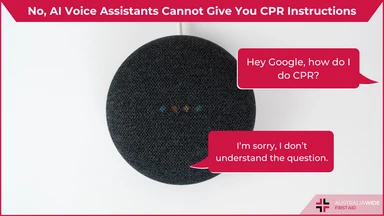
The use of AI is growing ever more expansive. These assistants, however, don’t seem to be useful in a crisis.
September 6, 2023
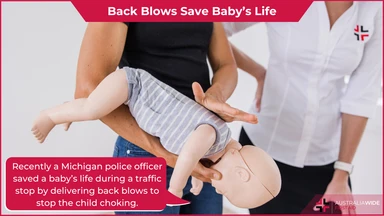
Recently we saw news of a Michigan police officer saving a baby’s life during a traffic stop. In the dramatic and disturbing footage, the officer delivered back blows to stop the child choking. Had he not acted quickly, the outcome could have been a tragedy.
May 3, 2023
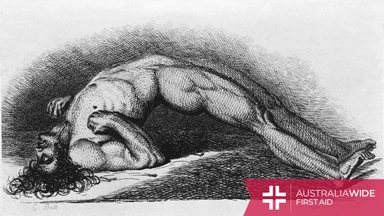
Australia has experienced a recent spike in tetanus, a bacterial infection caused by the bacterium Clostridium tetani. This bacterium can enter the body through open wounds and cause muscle stiffness, muscle spasms, and, in severe cases, death.