

No, Siri Cannot Give You CPR Instructions

The use of AI is growing ever more expansive. It’s in our smart phones, our computers, and our voice assistants. About 42% of Australians use a voice assistant such as Siri, Google Assistant, or Amazon Alexa. These assistants, however, don’t seem to be useful in a crisis.

A recent study explored the use of AI voice assistants to give advice during a medical emergency requiring CPR.
The idea behind this stems from two areas. The first is that almost half of all out-of-hospital cardiac arrest incidences have CPR performed by a layperson. This is despite the widespread availability of CPR courses like ours.
The second factor is the pervasive use of voice assistants throughout society. People use their Siri, Home, or Alexa for everything from finding out the weather to adding items to online shopping carts.
It is not unreasonable to expect a person facing an emergency to ask an AI voice assistant for what to do.
The researchers noted that responders to an emergency could acquire verbal instructions for CPR from emergency dispatchers, but that these services are not universally available. They may also be limited by language, audio quality, disconnection, fear of law enforcement, and perceived costs.
The results of the study were very underwhelming.
Almost half of all queries were answered with unrelated information.
Only 28% of the responses suggested calling emergency services.
This means in an emergency, asking an AI voice assistant would prove to be a very costly waste of time. Delaying medical attention can be fatal, as could spending time trying to get a useful answer out of an AI voice assistant.
The study suggests that responders to an emergency should prioritise calling emergency services, rather than trying to get an AI voice assistant to help.

Here lies the future potential of AI voice assistants. With such technology available in almost half of Australian households, it is feasible that they could become a source of information in a crisis.
The researchers have suggested the following for voice assistant technology, which we have expanded upon:
They suggested that the technology industry partner with the medical community and professional societies to standardize VA support for CPR instruction.
The study truly highlights how irreplaceable first aid training is. Knowing that you have the knowledge and skills to respond in an emergency is priceless.
Since you cannot rely upon the technology in your house, you must rely upon yourself.
Keeping your training up to date is the best way to help save a life should a tragedy occur.
Use our Find a Course Near Me function at the top of this page, and upskill yourself with this incredibly important knowledge today!
The study discussed can be found here: Quality of Layperson CPR Instructions From Artificial Intelligence Voice Assistants William Murk, MD, PhD, MPH, MS1; Eric Goralnick, MD, MS2,3; John S. Brownstein, PhD3,4; et al
September 6, 2023
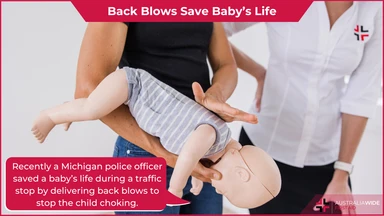
Recently we saw news of a Michigan police officer saving a baby’s life during a traffic stop. In the dramatic and disturbing footage, the officer delivered back blows to stop the child choking. Had he not acted quickly, the outcome could have been a tragedy.

May 3, 2023
Australia has experienced a recent spike in tetanus, a bacterial infection caused by the bacterium Clostridium tetani. This bacterium can enter the body through open wounds and cause muscle stiffness, muscle spasms, and, in severe cases, death.
April 26, 2023
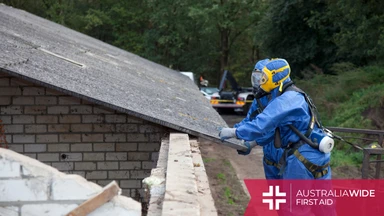
Asbestos is a group of naturally occurring minerals that were once widely used in Australia's construction industry. Though it has since been banned due to its highly toxic impact on human health, asbestos remains a lingering issue in Australia.