

The Formidable King Brown Snake

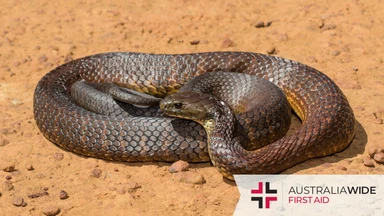
The King brown snake, otherwise known as the Mulga snake, has the widest distribution of any Australian snake.
They also have highly potent venom that can be injected in enormous quantities.
In this article, we will help you become better acquainted with the King brown and snake bite first aid.
We also cover snake bites in our general and childcare first aid courses - head to our website to find and enrol at a training location near you today.
The King brown is the most widely distributed snake in Australia. They can be found throughout the mainland, save for the furthermost southern and south-eastern parts.
They can thrive in a wide variety of habitats, including:
In these habitats, they shelter in or under:
The Australia king brown predominantly feeds on vertebrate prey, including:
They are seemingly immune to bites from their own species and at least one of their snake prey, the Western brown (Pseudonaja nuchalis).
They may be active during the day and night, though with diminished activity at midday and from midnight to dawn.
When threatened, the King brown will thrash its head and neck from side to side and hiss loudly.
If pressed further, it will subsequently lash out and bite its victim, even hanging on and chewing to express an enormous quantity of venom.
Their venom is highly toxic and can attack nerve cells, blood cells, and muscle.
As such, any bite from a King brown should be treated as a medical emergency with the Pressure Immobilisation Technique. Head to our article on snake bite first aid for more information.
Despite their name, the King brown is a member of the black snake genus and so their bites necessitate Black Snake Antivenom.
It is important to remember, snakes will never go out of their way to attack you.
As such, the best way to avoid a snake bite is to refrain from approaching, capturing, or killing snakes at home or in the wild.
If you need a snake relocated from your property, contact a professional snake catcher.
And for hands-on experience with managing snake bites, enrol in one of our general or childcare first aid courses.
We have training locations in every state, capital city, and major town throughout Australia - head to our website to find and enrol at a training location near you today.
April 12, 2023
Despite its cooler climate, Melbourne is teeming with a variety of snake species, some of which are among the deadliest in the world. In this article, we will familiarise you with 4 of Melbourne's most common snake species and how to treat their bites.
April 11, 2023
Renowned for its visually striking features, the Australian crab spider can be found in a variety of habitats, including urban areas. They have been known to bite when threatened, and their venom can cause pain, redness, and even dizziness.
April 10, 2023
The Grey snake is a venomous member of the Elapidae snake family. They are known to inhabit woodlands and eucalypt forests in Queensland and New South Wales. Their venom contains procoagulants that can cause significant pain and swelling.