

First Aid for Teddy Bear Bee Stings

Despite their cute name, Teddy bear bees can a give painful sting on par with that of the Fire ant.
These bees are also unique in that they are solitary creatures, with females building individual nests in soft soil.
Their nests can be found in a variety of regions throughout Australia, and they play an important role in pollinating our flowering plants.
In this article, we will help you become better acquainted with the Teddy bear bee and provide information on what to do if you are stung by one.
We also cover bee stings in our first aid courses:
To book a course near you, head to the Locations page on our website.
The Teddy bear bee (Amegilla bombiformis) has the following identifying characteristics:
These Australian native bees are widely distributed throughout the country, except for Tasmania.
Unlike European honeybees, Australia's common domestic honeybee, Teddy bear bees are solitary creatures.
Females build small burrows for themselves in soft soil near creek banks or underneath houses.
In saying that, Teddy bear bees may build nests close to one another in ideal locations.
Teddy bear bees, or Golden haired mortar bees, play an important role in pollinating Australia's flowering plants, as they are buzz pollinators.
Buzz pollinators create vibrations that cause tiny capsules in certain plant species to open and release pollen.
Unfortunately, ongoing land clearing for human development represents a major threat to native bee habitats.
To help combat this problem, you can plant nectar rich flowers in your backyard to create a native bee-friendly sanctuary.
To teat a Teddy bear bee sting:
The Teddy bear bee is a plump, furry creature that plays an important role in pollinating Australia's flowering plants.
Like most bees, they have a painful sting that can be treated with a cold compress and hydrocortisone cream.
To learn more about treating bee stings, enrol in one of our first aid courses:
Head to the Locations page on our website to book a course near you today.
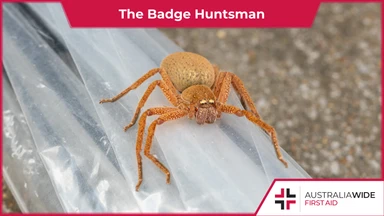
December 30, 2022
Found throughout Australia, including the cold climates of Tasmania, the Badge Huntsman is feared for its ability to climb quickly across walls and ceilings. They can also deliver a nasty bite comprising pain, sweating, and nausea.
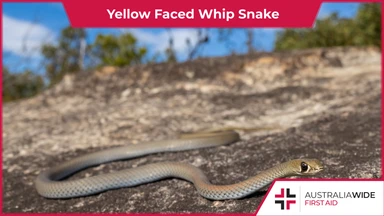
December 29, 2022
The Yellow faced whip snake is common throughout the greater Brisbane area. A shy and nervous species, the Yellow faced whip will bite when threatened, and its venom can cause severe symptoms like localised pain and swelling.
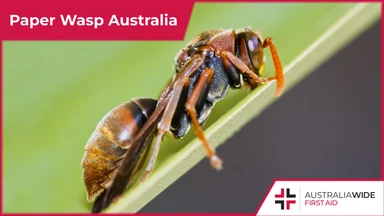
December 28, 2022
The Paper wasp is common throughout Australian homes, gardens, and bushland. Important to native ecosystems, Paper wasps have been known to aggressively defend their nests when threatened and cause painful stings.