

The Jumping Green Spider of Australia

The jumping spider family boasts over 5,800 species, making it the most diverse of all spider families, and as their name implies, they are proficient jumpers.
Because they are diurnal predators (they hunt in the daytime), it is not unusual to observe them leaping around your garden or even inside your home.
Today we’re talking about the Green Jumping Spider, also known as Northern Green Jumping Spiders. Its scientific name is Mopsus mormon, though in some older literature it’s referred to as Mopsus penicillatus.
If you’d like some hands-on experience dealing with bites and stings, you can attend one of our general or childcare first aid courses. We have training locations across most places in Australia.
The Green Jumping Spider is the largest jumping spider found in Australia.
The male Green Jumping Spider is bright green in colour, with a dark red head. Their legs are green to dark red, and they have a hairy white crown, with a topknot of black hairs. Their body typically grows to about 15mm in length.
The female Green Jumping Spider is usually about 10mm in length, but can grow up to 18mm. She doesn’t have a white crown or a topknot, and is instead almost entirely green – though she does have a white and brownish-red pattern on her thorax.
The Green Jumping Spider is very common in Queensland, but it can also be found in northern New South Wales, the Northern Territory, northern Tasmania, and Western Australia.
They’re typically found in wet forests and gardens, and are known to venture into urban areas – such as Brisbane – to live in leafy, well-watered gardens.
They live in trees and shrubs, where they’re found hunting.
Green Jumping Spiders hunt actively during the day, typically on foliage where they can camouflage against the green leaves.
They don’t build a capture web, because they are active hunters that jump on their prey, but they do build a silken shelter for resting, moulting, and laying egg sacs.
This spider typically preys on insects and other spiders.
Green Jumping Spider females build their nests and egg sacs on a single curved leaf. Males and females may live in the same nest during mating season.
There is no known danger from a Green Jumping Spider. However, it does have large fangs that can cause a painful bite in humans, as well as numbness and/or swelling.
You can apply a cold compress to the bite site for periods of up to 20 minutes to lessen the pain.
Do NOT use the Pressure Immobilisation Technique, as the venom moves slowly and this will just worsen the pain.
As for all bites and stings, if symptoms persist and/or you’re worried, seek medical attention.
Keep in mind – there have never been any deaths attributed to the Green Jumping Spider, and it’s usually a timid, unaggressive species.
For more information about the most common spider species in Australia and how to treat their bites, please head to our Resource Library.
The Green Jumping Spider (mopsus mormon) is a spider species commonly found along Australia’s east coast.
While it’s one of the largest jumping spider in Australia, it’s neither dangerous nor aggressive. And even though their bite can be painful, it typically isn’t cause for concern.
If you’d like some hands-on experience dealing with bites and stings, you can attend one of our general or childcare first aid courses. We have training locations across most places in Australia.
We run certified CPR and First Aid courses throughout all major Australian cities. Find a location near you.
April 5, 2023
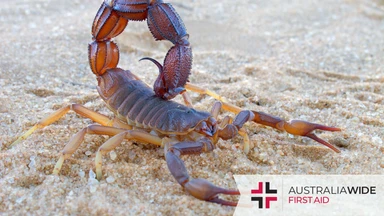
Though we are renowned for our wide variety of venomous snakes and spiders, Australia is also home to more than 100 species of scorpions. And while they typically live in remote habitats, they have been known to enter homes and inflict painful stings.
April 3, 2023
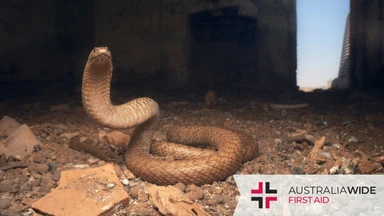
Though it's lesser known than its Eastern counterpart, the Western Brown Snake is highly dangerous to humans. Not only does it inhabit a wide variety of environments, but it is also nervous, fast-moving, and has potent venom that attacks the nervous system.
March 29, 2023
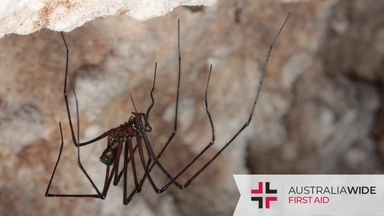
The Tasmanian cave spider is a fascinating arachnid that is endemic and exclusive to the island of Tasmania. They live in dark, moist environments throughout the island, especially caves. Despite their small body size, their legs can span a whopping 18 centimetres.